

What to Know Before Specifying a Preserved Moss Wall
Nine times out of ten, when a moss wall installation runs into a snag, the problem started weeks earlier, at the drawing stage, not on site. Someone assumed something about the material that wasn't true, and by the time anyone caught it, framing was already up.
Here's what tends to get missed, and what to lock down before it becomes a problem.
Say "preserved," not just "moss wall," on the drawings
This sounds like a small thing. It isn't.
A preserved moss wall doesn't need irrigation, drainage, or grow lights. No plumbing rough-in. No electrical, unless someone's specifically adding integrated LED accents as a design choice, which is optional, not required for the moss itself to hold up.
The problem is that "green wall" as a category usually does need all of that. If a mechanical consultant sees "moss wall" on a drawing set with no further note, they might reasonably plan for a living system, because that's what most green walls are.
We've seen irrigation get roughed in for a wall that never needed a drop of water. Writing "preserved, not living" directly on the spec sheet heads that off before it costs anyone money.
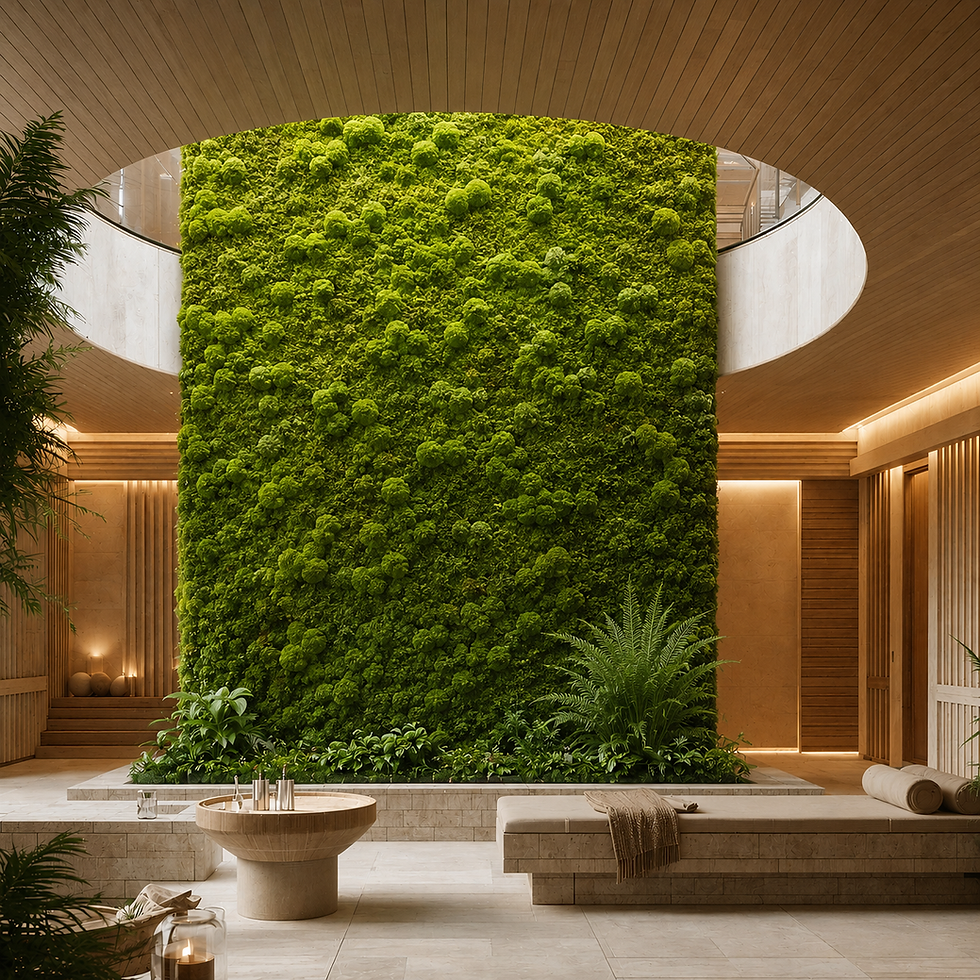
The site matters more than people think
Three things decide whether a spot will actually work, and none of them have to do with how the design looks on paper.
Direct sun is the big one. It fades the colour and dries the material out faster than regular indoor light does. A wall planned for a south-facing curtain wall either needs a different spot or some kind of adjustment, not a note telling someone to keep an eye on it.
Then there's HVAC. A vent blowing straight onto the wall will dry it out well ahead of an identical wall installed a few feet to the left, out of the airflow. This is worth a five-minute conversation between the designer and whoever's got the mechanical drawings, ideally before the wall's final position gets locked in.
And humidity. Preserved moss holds its texture best somewhere in the 40 to 60 percent range. An unconditioned vestibule that swings hard between seasons is a tougher spot than an interior room with steady HVAC.
None of this rules a location out. It just needs to come up early, not get discovered during a walkthrough after the wall's already built.
Get real drawings to the GC before installation week
A moss wall isn't a stock item. It gets built to the actual dimensions of the space, which means someone needs to go measure it properly before fabrication starts, not estimate off a floor plan. That same visit is a good chance to check for framing issues or clearance problems around outlets and trim.
Once the wall is fabricated, the GC should have production drawings in hand well before install day. On a bigger job, where the moss wall is one piece of a much longer finishing punch list, that's the difference between the crew planning around the install and just reacting to it when the crew shows up.
Questions worth asking before you sign off on a spec
How long from site visit to install? Does the fabricator actually provide production drawings, or just show up with the finished piece? What happens if something about the site changes between the design phase and installation?
A supplier who can answer all of that clearly, in writing, before the project even starts is usually a good sign for how the rest of it will go.
Bottom line
None of this is complicated. It just needs the same kind of upfront thinking any custom feature needs: know what systems it actually requires, which is fewer than people assume, think about sun and airflow while the design's still on paper, and make sure the GC has real drawings before install week starts. Handle that much, and a preserved moss wall is one of the easier things on a finish schedule, not one of the harder ones.
Frequently asked questions
Does a preserved moss wall need plumbing or drainage?
No. It requires no irrigation, drainage, or water supply of any kind.
Does a preserved moss wall need electrical work?
Only if the design specifically calls for integrated lighting. The moss itself needs no electrical connection.
What site conditions affect a preserved moss wall?
Direct sunlight, direct HVAC airflow, and unstable humidity are the three things to plan around.
Who should be involved when specifying a preserved moss wall?
Ideally the architect or designer, the general contractor, and the fabricator, talking to each other before final drawings lock in.
How far in advance should a preserved moss wall be planned?
As early as possible. A site visit and production drawings both need to happen before fabrication, and fabrication has to happen before installation week.
Specifying a preserved moss wall for an upcoming project?
We do a site visit and hand over production drawings before fabrication starts, so your GC has what they need going in.
Contact Evergreen Escapes to talk through a project or request a specification checklist.


Comments