

Lighting a Preserved Moss Wall: What Actually Makes the Texture Read
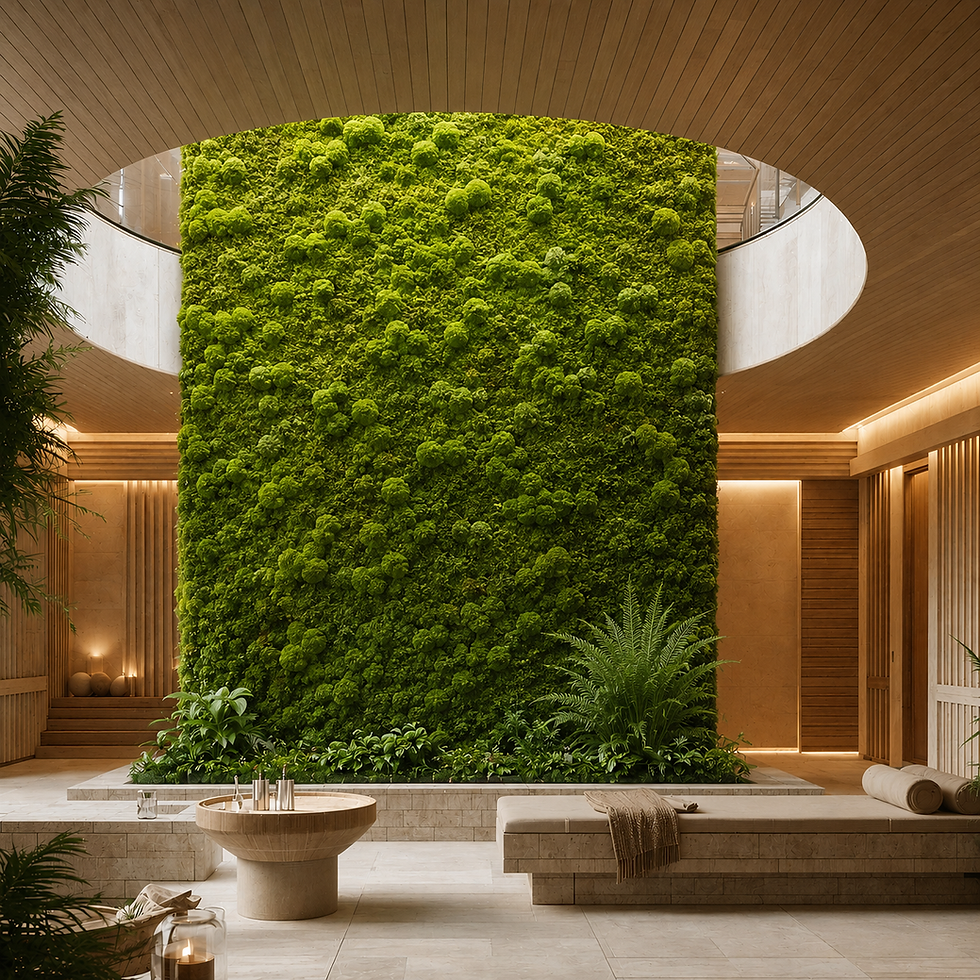
A preserved moss wall is a texture-first surface. Depth, tonal shift, the difference between pole/bun moss and carpet/flat moss, the way a sculptural composition catches shadow, none of it reads properly under the wrong light. Two identical walls, one lit well and one lit as an afterthought, look like different products.
This is the part of the specification that tends to get decided last and matters more than most people expect. Here is how to think about it.

Moss is a matte surface, so it reflects almost nothing back
Stone throws light around. Gloss finishes bounce it. A moss wall does the opposite, it absorbs and diffuses. That is exactly why it feels calm in a room, and also why it needs light delivered to it rather than assumed to arrive on its own.
Ambient ceiling light, the kind that lights the whole room evenly, tends to flatten a moss wall. It removes the shadow that gives the texture its dimension. The wall still looks fine. It just stops looking like the thing you paid for.
Why grazing angle is the heart of moss wall lighting
The single most useful principle: light that travels across the surface at a shallow angle reveals depth. Light that hits it straight on erases it.
This is called grazing, and it is why the same wall can look three-dimensional and rich or flat and photographic depending on where the fixture sits. A linear fixture mounted close to the wall and aimed down the face of it will pull out every ridge, mound, and tonal change in the composition. A downlight sitting a metre out from the wall, pointed at the middle of it, will not.
For sculptural or mixed-texture walls, grazing is not optional. The composition strategy, the reason a custom wall costs what it costs, only becomes visible when the light rakes across it.
Colour temperature changes the greens; moss wall lighting
Preserved moss holds its natural colour range: deep forest tones, softer sages, the occasional near-chartreuse in certain blends. That range shifts under different light.
From our experience, 2700K is the colour temperature that consistently serves a preserved moss installation. That warmer light holds the depth in the greens and keeps the wall reading rich rather than flat. It suits the full range of interiors we work in, from lobbies and reception areas to corporate and clinical spaces. Cooler light climbs in the opposite direction: by 3500K the warmth in the moss starts to drop out, and above 4000K the greens can grey out entirely. Keep the wall on 2700K even when the surrounding space runs cooler, and give it its own lighting logic rather than defaulting it to the ceiling grid.
The practical move is to keep the moss wall on its own lighting logic rather than defaulting it to whatever the rest of the ceiling grid is doing.
Keep the heat and the airflow off the moss
Two things worth coordinating early.
First, fixtures that run hot should not sit hard against the surface. LED sources run cool enough that this is rarely a problem, which is one more reason they have become the default here.
Second, and this is a care point, not a lighting point, but it lands in the same coordination conversation, a preserved moss wall should sit out of the direct airflow of a duct or vent opening. When lighting and mechanical are both being laid out near the feature wall, that vent clearance is the thing to protect. There is no watering, no misting, no humidity requirement to manage. Just keep it out of the direct draft.
Where this belongs in the process
Lighting a moss wall well is a coordination task, not a fixture-shopping task. It gets decided alongside the reflected ceiling plan, not after the wall is up.
The questions worth asking at the drawing stage:
Is there a linear fixture positioned to graze the surface, or only ambient light arriving from across the room? What colour temperature is the wall being lit at, and does it match the mood the space is going for rather than just the ceiling default? Is the fixture location clear of the vent-clearance zone the installation needs anyway?
Settle those three, and the wall reads the way it was composed to read. Leave them to site day, and you are relying on luck.
Evergreen Escapes designs and builds custom preserved moss installations for commercial interiors across Toronto and Ontario, integrated to your drawings. Installations are built to last at least 10 to 15 years in a properly maintained interior environment, with no watering or misting required.


Comments