

The Preserved Moss Wall: Real Texture, Nothing to Manage
A living wall needs someone checking on it. A water feature needs drainage and a plumber on call. A preserved moss wall just sits there, looking better than most things in the room, for years, without anyone thinking about it again after installation day.
That's the whole pitch, really. But it's worth understanding what's actually going on with the material, because most people who've never seen one assume it works like a plant. It doesn't.

What preserved moss actually is
Preserved moss starts out as real moss. It gets harvested, then run through a process that replaces its natural moisture with a preserving solution, which is what locks in the colour and keeps it soft. What you end up with sits in its own category, grown material that's no longer alive, and that in-between state turns out to be exactly what makes it useful.
A living wall looks great on day one and then becomes a small ongoing project, irrigation lines, grow lights, someone who knows plants checking in regularly. A faux panel skips all of that but usually looks like exactly what it is the moment you're standing close to it. Preserved moss gets you the depth and colour variation of something that actually grew, in a form that behaves more like upholstery or millwork than a garden.
Why preserved moss keeps showing up in good spaces
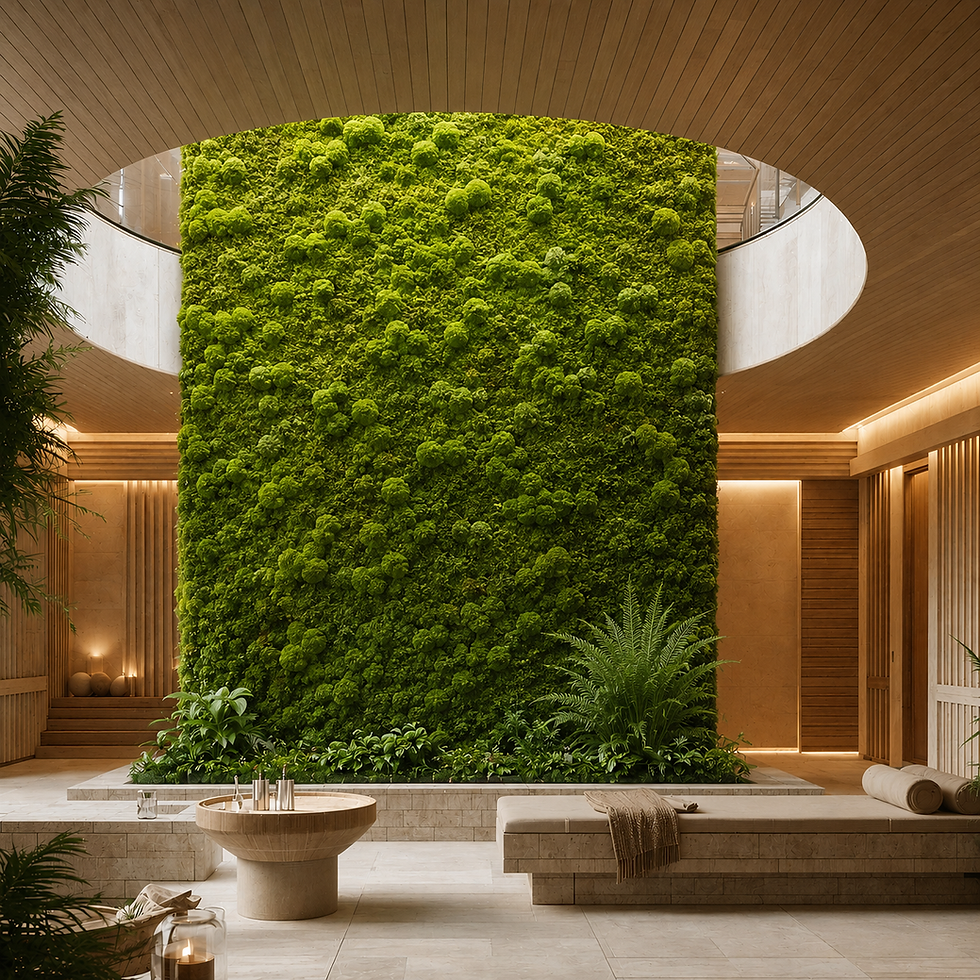
Walk into enough hotel lobbies, wellness studios, or corporate reception areas lately and you'll start noticing it. There's a reason.
Most interiors right now lean hard on glass, concrete, and drywall. Those materials are fine, but they're flat, and a room full of them can start to feel a little sterile. Moss breaks that up. It adds colour variation and a texture your eye actually wants to rest on for a second.
It also does something for the acoustics of a room, which nobody thinks about until they're standing in a lobby where every conversation echoes. Hard, open spaces reflect sound. A textured surface absorbs some of it instead. A moss wall isn't a substitute for real acoustic engineering, but in a reception area or open office, it takes the edge off.
And there's a branding angle too. A wall built to a project's actual drawings, in a blend chosen for that specific space, reads differently than something ordered from a catalogue and hung up. People notice the difference even if they can't say exactly why.
Then there's the part that gets undersold: once it's installed, there's genuinely nothing to do. Keep it out of direct sun, keep it away from a vent that's blasting air on it all day, and it'll hold its colour and shape for at least 10 to 15 years. An occasional pass with a soft brush or a can of compressed air handles the dust. That's it. No schedule, no contract, no calls to make.
Where it makes sense
Lobbies and reception desks are the obvious fit, since that's the first impression of a building and moss does a lot of work in that role. But it shows up just as well in a boardroom, a wellness studio, a boutique retail wall, or a private office that wants to feel considered rather than furnished. Because it's built to the project's own drawings rather than pulled off a shelf, it can wrap a column, follow a curve, or work a logo into the design if that's what the space calls for.
The short version
It's grown material, real moss, that happens to need nothing from you once it's up. For a lot of spaces trying to feel warmer and more considered without adding another thing to manage, that's a hard combination to beat.
Frequently asked questions
What is a preserved moss wall? A wall or panel made from real moss that's been treated through a preservation process to hold its colour and soft texture for years, without soil, water, or light.
Does a preserved moss wall need watering or sunlight? No. It needs no watering, no misting, and no supplemental lighting. It holds up best out of direct sunlight and away from constant HVAC airflow.
How long does a preserved moss wall last? At least 10 to 15 years, installed in a stable interior environment.
Is a preserved moss wall the same as a living wall? No. A living wall uses actual growing plants and needs irrigation and regular horticultural care. A preserved-moss-wall uses real moss that's no longer living and needs none of that.
Where does a preserved moss wall work best? Lobbies, reception areas, boardrooms, wellness studios, and retail spaces, anywhere a natural, textured focal point is wanted without taking on a maintenance commitment.
Considering a preserved moss installation for your space? We do a site visit before any fabrication starts, so the design gets built around your space from the beginning, not adjusted after the fact. Contact Evergreen Escapes to arrange a studio visit or talk through a project.


Comments