

Preserved Moss Wall Lifespan: How Long Does a Moss Wall Really Last?
One of the first questions clients ask before investing in a moss feature is simple:
How long does a preserved moss wall last?
The answer depends on the environment.
A preserved moss wall is made from natural moss that has been stabilized so it keeps its colour, texture, and softness without needing water, soil, or sunlight. It is no longer living, which is exactly why it works so well in offices, lobbies, clinics, showrooms, and interior commercial spaces.
But preserved does not mean indestructible. It is still a natural material.
The preserved moss wall lifespan depends on where it is installed, how the space is conditioned, and how well the wall is protected from sun, airflow, moisture, and touch.

What Is Preserved Moss?
Preserved moss is real moss that has gone through a preservation process. The purpose is to maintain its natural appearance while stopping the biological growth cycle.
This is why preserved moss does not need:
Water
Soil
Sunlight
Irrigation
Pruning
Fertilizer
Plant replacement schedules
That makes it different from a living wall. A living wall is a plant system. A preserved moss wall is a natural preserved material system.
This distinction matters because the lifespan of preserved moss depends less on plant care and more on interior conditions.
How Long Can a Preserved Moss Wall Last?
In a suitable interior environment, preserved moss can last for years. Many preserved moss suppliers and installers commonly describe lifespan in multi-year terms, often around several years or longer depending on conditions. However, exact lifespan should not be treated as a universal guarantee because preserved moss responds to the room environment.
For example, a moss wall in a stable office reception area will usually have better conditions than a moss wall near a sunny window, exterior door, air vent, or high-touch corridor.
The Ideal Environment for Preserved Moss
Preserved moss performs best indoors under stable environmental conditions.
Several preserved moss maintenance sources identify moderate indoor humidity as important. One preserved plant maintenance guide recommends humidity between 40% and 60%. It also notes that very dry environments may cause reindeer moss to become dry or hard.
For practical planning, the strongest environment is:
Interior only
Stable humidity
No direct sun
No watering
No misting
No strong HVAC airflow
Minimal touching
No cleaning chemicals
Does the Type of Moss Affect Lifespan?
Yes. Different moss types have different textures, densities, and sensitivities.
Common preserved moss types include:
Reindeer moss
Flat moss
Pole moss
Mood moss
Fern elements
Mixed botanical accents
Reindeer moss is soft, dimensional, and visually strong, but it can become firmer in dry environments. Flat moss has a lower profile and may be better suited for certain architectural applications. Mixed moss walls can create visual depth, but they also require thoughtful placement and handling.
The design should match the location. A high-touch hallway may require a different strategy than a protected boardroom feature wall.
Is Preserved Moss Better Than a Living Wall for Longevity?
Yes.
A living wall can be beautiful, but it requires irrigation, light, drainage, plant health monitoring, pruning, and replacement. A preserved moss wall avoids most of that complexity because it is not living.
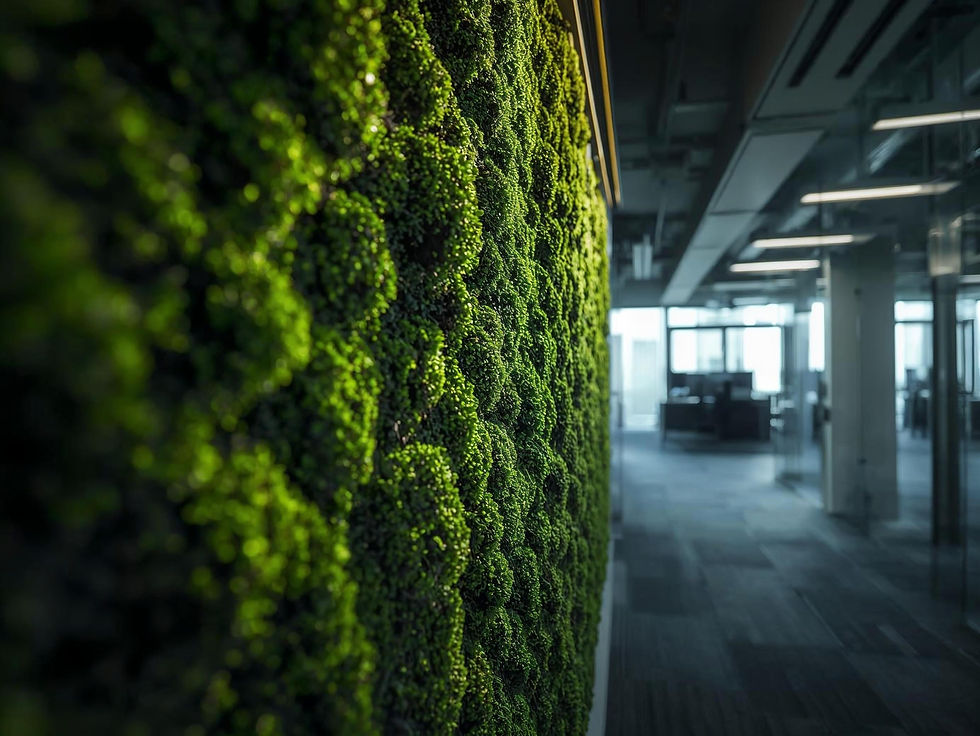
For offices and commercial interiors, preserved moss is often the more practical option when the goal is visual biophilic impact with low maintenance.
However, preserved moss is not suitable for every location. If the space has high moisture, direct sun, or constant physical contact, the installation should be reconsidered or redesigned.
Final Thought
The preserved moss wall lifespan depends on one core principle: environmental control.
The best results come from planning the moss wall as part of the architecture, not treating it as an afterthought.
A preserved moss wall lasts longest when the design, placement, and environment work together.


Comments