

Moss Wall Toronto: A Practical Guide to Custom Preserved Moss Installations for Commercial Interiors
If you have been searching for a moss wall in Toronto, you have probably already noticed that the options fall into two very different categories.
On one end, there are decorative panels, pre-made, modular, sourced from a catalogue, and installed quickly. On the other end, there are custom preserved moss wall installations designed from scratch, built to your drawings, and integrated into the architecture of a specific space.
This guide is about the second kind.
It covers what a preserved moss wall actually is, where it works well in commercial interiors, what the installation process looks like, and what to ask before committing to a project.

What Is a Preserved Moss Wall?
A preserved moss wall is made from natural moss, reindeer moss, pole moss, flat moss, or a combination that has been harvested, processed, and stabilized. The preservation process replaces the moisture in the plant cells with a non-toxic fluid that keeps the moss soft, supple, and visually intact over time.
The result is a material that looks and feels like living moss, but is no longer living. It does not need water, sunlight, soil, irrigation, or any ongoing biological maintenance. It is, by its nature, a maintenance-free moss wall.
In the right interior conditions, a properly installed preserved moss wall lasts at least 10 to 15 years.
That lifespan is one of the main reasons architects and designers in Toronto have started specifying preserved moss as a serious material rather than a novelty feature.
Why Toronto Commercial Interiors Are a Strong Fit
Toronto's commercial market has specific characteristics that make preserved moss a practical specification choice.
The city's climate creates real challenges for living wall systems. Cold, dry winters push interior humidity down significantly. HVAC systems run hard from November through March. Living walls in this environment require significant mechanical support, humidification, grow lights, irrigation scheduling, and drainage management, which adds cost and complexity to any project.
Preserved moss sidesteps all of that. The material is already stabilized. It does not respond to seasonal shifts the way a living system does. As long as the interior maintains reasonable humidity and the wall is positioned correctly, the installation performs consistently year-round.
For design teams working on commercial projects in Toronto, offices, lobbies, hospitality spaces, retail environments, this is a material decision that holds up operationally, not just aesthetically.
Where Preserved Moss Works in Commercial Spaces
The most common question designers ask early in a project is simple: where does this actually belong?
The honest answer is that placement determines almost everything. Preserved moss performs best in areas where the environmental conditions are stable and where people will encounter the wall visually rather than physically.
Offices
A preserved moss wall for an office most commonly appears in reception areas, boardrooms, wellness rooms, and executive environments. These are spaces where clients form first impressions, where visual calm matters, and where a natural material adds something that glass and drywall cannot.
The material is particularly effective behind reception desks, where the wall becomes a backdrop that communicates brand and spatial care simultaneously. It also works well in corridors that would otherwise be visually neutral.
Lobbies
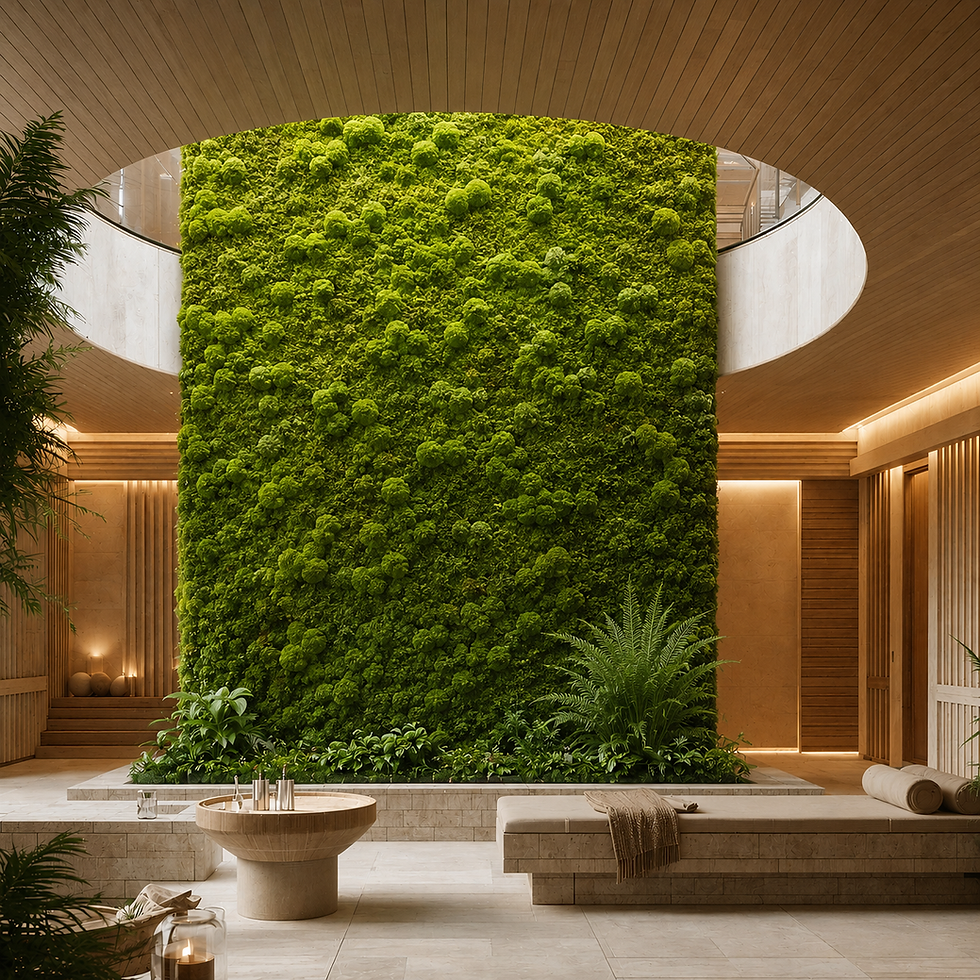
Lobby installations tend to be larger in scale and more architecturally considered. A moss wall for a lobby in Toronto often involves coordination with lighting, millwork, and material adjacencies, such as stone, concrete, metal, or glass panels that the moss needs to read well alongside.
Backlighting is one of the most effective ways to treat a lobby moss wall. Even low-heat LED perimeter or wash lighting brings out the texture of the moss without generating the heat that would degrade it. The effect is controlled and genuinely architectural.
Restaurants and Hospitality Spaces
A moss wall for a restaurant operates differently from an office installation. Hospitality environments have more moisture variation, more foot traffic, and more physical contact risk. The wall needs to be positioned thoughtfully, typically away from the kitchen pass, away from bar condensation, and not in a location where guests will lean against it.
When positioned correctly, moss in a restaurant or hospitality interior creates exactly the kind of atmosphere that makes a space memorable. It softens acoustics, introduces organic texture into what is often a very hard-surfaced environment, and gives the space a visual identity that photographs well.

Custom Preserved Moss Wall Installation: What the Process Looks Like
A custom moss wall installation in Toronto is not a product delivery. It is a design and fabrication process. Understanding that distinction matters before engaging any studio.
Here is how the process typically unfolds.
Site visit first. Before fabrication begins, the wall is assessed in person. Dimensions are verified against architectural drawings. The proximity to HVAC vents, natural light sources, and adjacent materials is reviewed. Any integration details, millwork, lighting, framing, and substrate conditions are confirmed.
Design development. Based on the site review and the project brief, at least two design options are prepared. These cover moss composition (species, colour palette, texture layering), panel arrangement, edge treatment, and lighting integration if applicable. The design is resolved before any moss is touched.
Fabrication. The installation is built in the studio according to the confirmed drawings. This is not a warehouse pick-and-ship operation. Each panel is fabricated specifically for the dimensions, composition, and specification of the project. Production typically takes four to five weeks from confirmed drawings.
Installation. The installation is coordinated on-site. Mounting, backlighting, shadow gaps, kickplate details, and material transitions are addressed during installation. The wall is complete before the team leaves.
What Makes a Preserved Moss Panel Custom, and Why It Matters
The term "custom" gets used loosely. In the context of a custom preserved moss panel, it has a specific meaning.
A truly custom preserved moss panel is built to your wall dimensions, not to a standard module size. The composition, which moss species, in what proportions, in what arrangement, is determined by the design intent of the space, not by what is available off a shelf.
This matters because preserved moss panels in commercial interiors live at the intersection of material and architecture. A panel that is 10 centimetres too short, or a colour palette that reads too warm against a cool stone, or a texture that is too uniform for the scale of the wall, any of these details affect whether the installation reads as intentional or approximate.
The difference between a decorative moss panel and a designed moss wall is the difference between something that was added to the space and something that belongs to it.
Biophilic Wall Installation in Toronto: The Design Principle Behind the Material
Preserved moss belongs to a larger category of design practice called biophilic design, the deliberate integration of natural materials, forms, and references into the built environment.
The research behind biophilic design is well-established. Spaces that incorporate natural materials and references to nature support cognitive function, reduce stress indicators, and improve the perceived quality of the environment. These effects are not cosmetic. They are measurable in occupant behaviour and spatial perception.
A biophilic wall installation in Toronto is not simply a decorative gesture. It is a material decision with functional implications for the people who use the space every day.
For commercial clients, particularly in corporate, hospitality, and wellness contexts, this is increasingly relevant to how spaces are evaluated, specified, and valued.
Preserved moss is one of the most practical biophilic materials available for commercial interiors. It is low-maintenance, architecturally flexible, fire-tested, and VOC-free. It works in spaces that cannot support a living wall system. It does not require specialist ongoing care. And when designed well, it reads as a natural extension of the architecture rather than an addition to it.
What to Ask Before Specifying a Preserved Moss Wall
If you are an architect, interior designer, or commercial project manager considering a moss wall for a current project, these are the questions worth resolving before the design is locked.
What are the environmental conditions at the proposed location? Relative humidity, proximity to HVAC outlets, and exposure to direct sunlight are the three most important variables. A site visit before specification is not optional; it is how you avoid placing a moss wall in a location that will shorten its lifespan.
Is this a custom fabrication or a modular product? The answer affects how well the installation integrates with the architectural intent of the project. Custom fabrication allows full control over dimensions, composition, and detailing. Modular products offer speed and lower cost at the expense of precision.
How does the wall integrate with the surrounding trades? Millwork, lighting, substrate, and mounting method all need to be coordinated. A moss wall specified in isolation, without reference to what it sits next to, often creates detailing problems during installation.
What is the maintenance protocol for the client? The answer is simple for preserved moss: no watering, no trimming, no system management. Standard humidity. No direct sunlight. No physical contact with the surface. Communicate this clearly to the facilities team before handover.
Evergreen Escapes: Custom Moss Wall Studio, Toronto
Evergreen Escapes is a Toronto-based studio specializing in custom preserved moss wall installations for commercial interiors.
Every installation is designed from the project drawings up. We conduct a site visit before fabrication begins. We prepare at least two design options per project. We fabricate in-studio to confirmed dimensions. We coordinate installation with the design team and surrounding trades.
We work with architects, interior designers, commercial builders, developers, and hospitality operators across Toronto, Ontario, and Canada.
Our moss wall installations last at least 10 to 15 years in properly controlled interior environments. They are maintenance-free, fire-tested, VOC-free, and custom-fabricated to project specifications.
If you have a project in scope, we are available to discuss scope, materials, and site conditions.
Contact: info@evergreenescapes.ca
Phone: 1 (888) 556-7687
Studio: Toronto, Ontario
Website: evergreenescapes.ca
Evergreen Escapes does not certify projects for WELL or LEED but works collaboratively with design teams to align preserved moss installations with project sustainability and wellness objectives.


Comments